Inventory Rotation
Analyze sales patterns and stock levels to make informed transfer decisions between locations with the Inventory Rotation report.
The Inventory Rotation module provides a comprehensive reporting and analysis tool for restocking operations between locations. It helps you analyze sales patterns at destination locations and available stock at central warehouses to make informed transfer decisions.
Before using the report, configure the module according to the Setup Guide.
❓ Introduction
Save time - instead of manually checking sales and inventory levels, you get all the data in one place.
Make better decisions - you see exactly what and how much was sold at each location, so you know what to restock.
Avoid shortages and overstock - replenish inventory based on actual demand, not guesses.
📋 Overview
The Inventory Rotation Report calculates and displays:
- Sales statistics from destination locations for a specified period
- Current inventory levels at both central and destination locations
- Available stock at the central location
- Suggested quantities for transfer orders in base or transfer units of measure
🚀 How to enable the module
Configure the module according to the Setup Guide, including the central and destination locations and calculation parameters.
⭐ Key Features
- 📊 Sales Analysis - See what and how much sold during a selected period (e.g., last 30 days, current month)
- 📦 Inventory Levels - View stock at central and destination locations
- 🎯 Flexible Filters - Limit view to selected items, categories, or variants
- 📝 Quick Orders - Specify quantities and create a transfer order with one click
- ⚠️ Validation - System warns about problems (insufficient stock, incomplete packages)
⚙️ How It Works
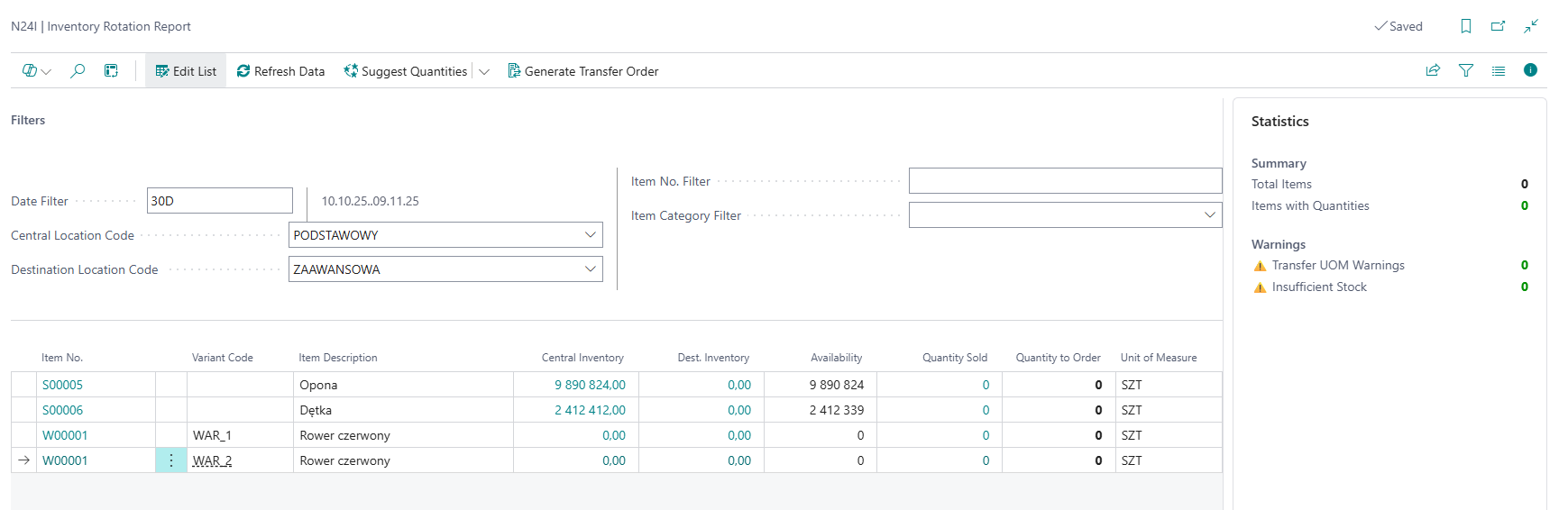
1. Open the Inventory Rotation Report
Navigate to the Inventory Rotation Report from the Reports and Analysis section in Business Central.
2. Configure Filters
The report requires you to set up filters before calculating data:
Required Filters
- Central Location Code - The warehouse where stock is available for transfer
Default value comes from configuration in Advanced Inventory Setup
- Destination Location Code - The location where items are sold and need restocking
- Date Filter - Period for sales calculation (e.g.,
30D,CM,1M,01/01/2024..01/31/2024)Default value:
30D(last 30 days) or value defined in Advanced Inventory Setup
Optional Filters
- Additional Item Filter - Limit analysis to specific items within the globally allowed items
You can click on the field to open filter builder and select items by number, type, or category
Global filter from Advanced Inventory Setup is always applied and cannot be removed by the user - this ensures only appropriate items are visible in the report
3. Load Data
Click the Load Data action to calculate inventory rotation statistics based on your filters. The system will:
- Find all items matching your criteria
- Calculate quantity sold at the destination location for the specified period
- Retrieve current inventory levels at both locations
- Calculate available stock at the central location
- Populate the report with all calculated data
4. Review the Results
Key columns in the report:
| Column | Description |
|---|---|
| Item No. / Description | Item number and name |
| Central Location Inventory | How much is in the main warehouse |
| Quantity Sold | How much sold in the selected period (click to see details) |
| Availability | How much you can transfer (includes open orders) |
| Qty. in Transfer UoM | Available quantity in transfer units (e.g., boxes, pallets) |
| Quantity to Order | Here you enter how much you want to transfer |
The report also contains additional columns: variants, destination location inventory, transfer units.
5. Specify Quantities to Order
You have several options to manage quantities:
Manual Entry
Enter the quantities you want to transfer in the Quantity to Order field. The system will automatically convert values between base units and transfer units.
Quick Actions for Quantities
- Suggest Quantities - Automatically fills Quantity to Order based on the difference between Quantity Sold and current Destination Inventory. Only affects items without existing quantities assigned.
- Round to Transfer UOM - Rounds down all Quantity to Order values to be evenly divisible by Transfer UOM, ensuring complete packages.
- Clear Quantities - Clears all assigned Quantity to Order values, allowing you to start fresh.
Warning
If the quantity is not evenly divisible by the transfer unit, the line will be highlighted in red to indicate a warning.
6. Monitor Statistics
The Statistics FactBox on the right side shows:
- Total Items - Number of items in the report
- Items with Quantities - How many items have specified quantities to order
- ⚠️ Transfer UOM Warnings - Items with division problems by unit
- ⚠️ Insufficient Stock - Items that cannot be transferred (not enough stock)
7. Create Transfer Order
You have two options for creating transfer orders:
Generate Transfer Order (New)
Click the Generate Transfer Order action to create a new transfer order. The system will:
- Validate quantity divisibility by Transfer UOM
- Check that the transfer route is properly configured
- Create a new transfer order with all items that have Quantity to Order specified
- Clear all assigned quantities after successful creation
- Prompt you to open the newly created order
Add to Existing Transfer Order
Click the Add to Existing Transfer Order action to add lines to an existing open transfer order. The system will:
- Search for open transfer orders matching the same location combination (from Central to Destination)
- If no matching orders are found - ask if you want to create a new one instead
- If one matching order is found - automatically select it
- If multiple matching orders are found - display a list to choose from
- Confirm before adding lines to the selected order
- Add all items with Quantity to Order specified to the selected transfer order
- Clear all assigned quantities after successful addition
- Prompt you to open the updated order
Important
Transfer route must be previously configured in the system. Search in Business Central: Transfer Routes.
Note
Lines can only be added to transfer orders with Open status. Released orders cannot be modified.
📅 Most Commonly Used Date Filters
The Date Filter field accepts standard Business Central date filter syntax:
| Filter | Description | Example Period |
|---|---|---|
30D |
Last 30 days | |
1M |
Last month | |
CM |
Current month | |
CW |
Current week | |
CY |
Current year | |
01/01/2025..01/31/2025 |
Specific date range |
⚠️ Common Issues
No items found
- Check if filters are correct
- Make sure items meeting the criteria exist
Transfer route not found
- Search in Business Central: Transfer Routes
- Specify the in-transit location
Divisibility warning
- Adjust quantity to full packages
Insufficient stock
- Check incoming deliveries
- Reduce the quantity ordered
- Consider transferring from another location
💼 Examples and scenarios
Replenish a destination location
Need: Review recent sales and replenish stock at a destination location from a central warehouse.
Configuration:
- Open the Inventory Rotation Report from Reports and Analysis.
- Set the Central Location Code, Destination Location Code, and Date Filter.
- Select Refresh Data and review Quantity Sold, inventory, and availability.
- Enter Quantity to Order for the items to transfer.
Result: The report shows the calculated sales and inventory values, and the selected quantities are ready to create a transfer order.
Prepare quantities in transfer units
Need: Create transfer quantities that align with the item’s transfer unit of measure.
Configuration:
- Refresh the report with the required central and destination locations.
- Use Suggest Quantities for lines without an assigned quantity.
- Review Qty. in Transfer UoM and adjust Quantity to Order when quantities must align with the transfer unit.
Result: The report converts quantities between base units and transfer units and highlights lines with transfer-unit divisibility warnings.
Create or update a transfer order
Need: Move the quantities selected in the report to a transfer order.
Configuration:
- Enter Quantity to Order on the required report lines.
- Select Generate Transfer Order to create a new order, or Add to Existing Transfer Order to use an open order with the matching location combination.
- Confirm the transfer order when prompted.
Result: The selected lines are added to a transfer order, and the saved quantities are cleared after successful creation or addition.